Within the first year of buying the farm I had 3 stark realizations, in the following order:
1. I hate mowing. 2. I am solely responsible for mowing. 3. I am failing wildly at the mowing.
There have been several incarnations of mowing apparati over the years. Mowers have come and gone. Mowers have idly awaited repair for long periods of time. I still do not have a satisfactory set of equipment to keep the farm in shape – and that’s in a shape that is far and away on the wild and unkempt side of ‘managed.’

Here’s a summary of what we’re looking at: In a 17 acre field, about 10 acres are leased out to a hay farmer, which is comical in juxtaposition to my chaos. The hay is mowed, completely, in neat rows, in an hour or so. Combed steadily into perfectly straight lines, then sucked up and bound into bales, all in impressive orderly fashion.
On the remaining acres under my supervision… neat, straight, and orderly do not spring to mind. When I started the farm, and as I mentioned in this prior post, I decided to leave most of the farm wild, applying the common forager principle to take no more than one third of an available resource. So it is with intention that much of the farm is left alone each season. Which brings us to our list of benefits to “not mowing much,” of which there are not quite 100, and in fact closer to 5.
1. Gorgeous Grasslands. Areas that have been mowed once or twice over the years have bounced back in lovely ways. Mugwort, a tall leafy annual with hearty stalks dominated much of the untouched landscape in year 1. But, mowed at the right time, mugwort has graciously yielded to the diverse meadow scape of today. Imagine a dozen varieties of flowering grasses with tassels, puffs, and tufts, in reds, purples, pinks, greens, and ambers filling up a lush spring meadow. I’ll steal a little bit for an early season bouquet, but mostly I enjoy just crouching down to marvel up close at the unique flowers and filling my view with their bright colors, which are extra-super-incredible after a long dull winter. A visitor from the Genesee Land Trust once informed me that mowing one third of meadow areas each year is advised, to keep it in meadow-not-forest shape. It seems like excellent advice, but I’m not looking forward to mowing the gorgeous grassland, even in 3 year intervals.

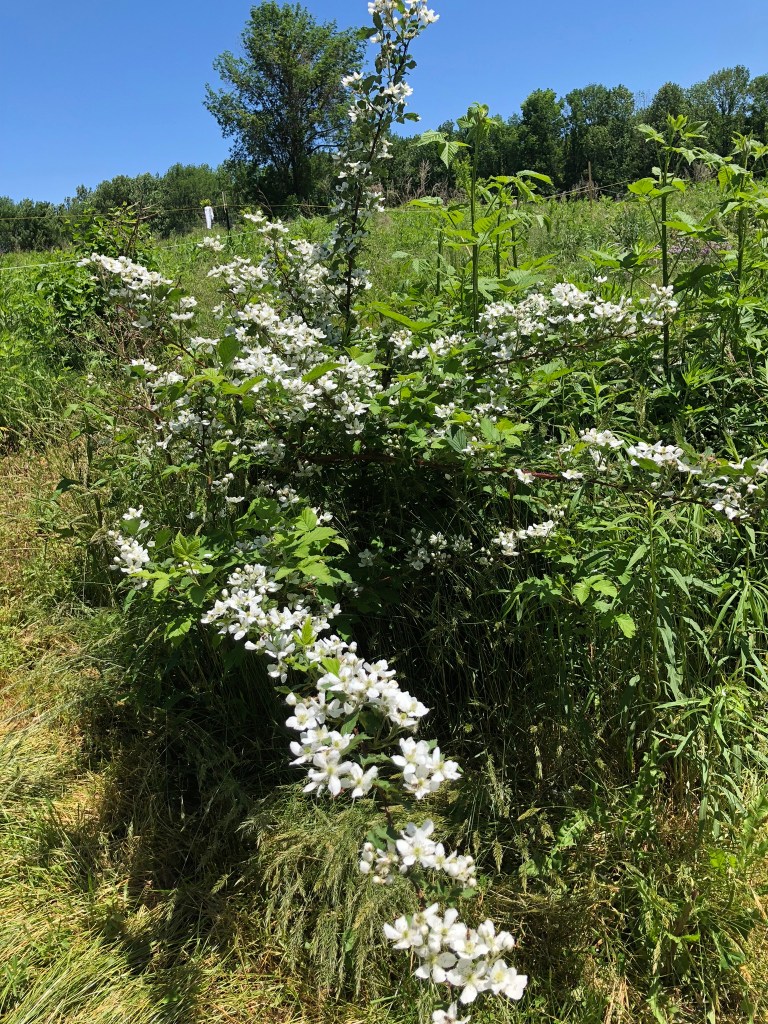
2. The berries. My word. This one makes me laugh. As a messy person, I’ve always rolled my eyes at that saying… something like, if you want to be successful, start by making your bed. I will do no such thing. But I also feel a bit guilty about being a bit messy. So when it pays off to be ‘low maintenance,’ I get to laugh a little. Blackberry patches have popped up all over the field. Delicious, gigantic berries last for most of the summer and we can all enjoy them because, you’re welcome, I didn’t mow!
3. Trees. I’ve planted a lot of trees over these years. About 80% have survived. But any tree that plants itself – by my observation, is growing stronger and faster and more independently than any one I plant. There are now 2 big strong mulberry trees at the front of the farm, far ahead of the mulberry trees I planted 3+ years ago. This year I also came across 2 different conifer species, one of which has super long pine needles, the likes of which I’ve really only seen in Florida, who I really hope is built to last up here! Black locust babes have popped up as well, growing as off-shoots from a mature mama tree. Some have naturally become “fence-post” edges of gardens and others I’ve tried to relocate (with moderate success) for a built “living fence.” Known for being fast-growing and amazing hardwood for building and burning, I encourage these guys as much as possible.
4. Wildflowers. Not far off from the aforementioned grasses, the wildflower meadows have increased in abundance and diversity year after year. Each season brings some new beauty to behold. And each new beauty seems to bring in new appreciative creatures as well. From time to time I actually do some research. Like the time that I was tired of being poked by thistle’s mighty thorns and wondered, who loves this plant? I like its flower but the rest is a burr! Turns out, there are bee species who depend on thistles to survive.
5. My absolute favorite benefit and another one that delights me wholeheartedly: Fireflies. If you haven’t heard, firefly populations are in decline. And everything I’ve read suggests some easy ways to encourage and protect firefly populations: Leave the leaves. Leave fallen logs. Leave some high grass. Be a messy farmer like me!! Additionally, darkness during their mating season is helpful – and the farm field is plenty dark! The fireflies start blinking in the evenings around the end of June each year. Every night in July is a spectacle, pure beauty, pure wow. The little lights are twinkling en masse along the messy edges of the field, blinking back and forth in courting, and perhaps also in gratitude and delight for a messy little place to spend their days, and of course their nights.
 Enka:ri Farm
Leave a comment